Several Ontologies, One Moral Rule
How Self-Definition Allows Conflicting Theories to Protect the Same Moral Conclusion.

Michael Inzlicht recently offered a particularly interesting example from his own experience as a researcher. He wrote about p-hacking, the practice of trying multiple analytical approaches until one finally produces a statistically significant result.
I became a social psychologist because I wanted to make the world a better place…
Looking back, Inzlicht recognized that some of his earlier work had relied on questionable research practices of this kind. What makes his reflection especially compelling, however, is not the methodological error itself, but how the process felt from the inside.
At the time, p-hacking did not feel like cheating. It felt like truth-seeking…
Inzlicht was studying questions tied to strong moral commitments. His work concerned discrimination and prejudice, and he understood it as contributing to a more just world. He already knew which side he was on, and he had a sense of which findings would fit the world he believed ought to exist.
The question gradually shifted from ‘What is true?’ to ‘How can I show that what I believe is true?’
Although the distinction might seem subtle at first, as both approaches involve analyzing data, testing hypotheses, and gathering evidence, the direction of the argument is fundamentally different.
- In the first approach, the outcome is genuinely up in the air, and the whole point of the analysis is to stress-test it.
- In the second, the answer already feels like a given: the analysis is just about finding a compelling way to show it.
Inzlicht’s example is not a simple story of conscious deception. It raises a more difficult problem:
How can the search for a desired result feel subjectively identical to an honest search for truth? How can moral conviction protect methods that the same researcher might immediately distrust if they supported a more neutral or politically unwelcome conclusion?
P-hacking might be a statistical term, but the mindset behind it extends far beyond data science.
We first decide what outcome we want, then judge every method, analogy, and piece of evidence by whether it gets us there. A favorable result is taken as proof. An inconvenient one is dismissed as a flaw in the method, a misunderstanding, or a bad-faith argument.
Inzlicht himself turns to Rebecca Tuvel’s article on transracial identity as one example of this wider problem. In 2017, Tuvel asked why certain arguments used to support transgender identities could not also support transracial identity.
✅️ She did not claim that race and gender were identical in every respect. She followed an analogy and asked whether the principles being invoked were genuinely general principles.
❌ The article nevertheless provoked an extraordinary institutional and moral backlash. Hundreds of academics called for its retraction, while members of the journal’s editorial board apologized for its publication.
The Tuvel controversy is therefore important for more than the question of whether the transracial analogy succeeds. Equally important is why the analogy itself came to be treated as a moral offence.
Which conclusions had already been established as permissible, and which had become unacceptable before the argument had even been examined?

This question leads back to a distinctive tension within contemporary gender discourse.
- One common account of binary transgender identity holds that a person possesses a deep, enduring, and authentic gender identity. This identity is not chosen but discovered. The classification assigned at birth, along with certain features of the body, may be mistaken about who the person truly is.
- Many nonbinary accounts move in a different direction. Rather than claiming that someone has been placed in the wrong category within the male–female division, they question the adequacy of the division itself. Identity may be intermediate, shifting, outside both categories, or expressed through a deliberate refusal to grant gender classification such a central role.
The first model tends toward essentialism. It assumes that a true identity exists beneath external classification.
The second often presents itself as anti-essentialist. It questions whether every person can or should be located within one of two stable gender categories.
Philosophically, these claims are difficult to reconcile. Politically, however, they belong to the same coalition. What holds them together?
Probably not a shared theory of what gender is. Agreement is not required on whether gender is innate or socially produced, stable or fluid, discovered or created.
The common ground is more likely normative: a person’s self-description possesses primary moral authority, and others are expected to recognize it.
This ethics of self-definition can unite conflicting ontologies. At the same time, it changes the conditions under which disagreement becomes possible. Once the moral authority of self-description becomes the coalition’s shared foundation, theoretical criticism can easily be interpreted as a denial of human dignity.
Tuvel’s transracial analogy makes this particularly visible. Her argument did not begin in mockery or explicit hostility. It tested whether self-identification, social construction, and the revisability of birth-assigned categories were genuinely general principles.
Yet the response suggested that certain questions could become transphobic or harmful merely by being asked.
This essay doesn’t begin by asking if every claim about transgender, nonbinary, or transracial identity is correct…
The real puzzle is how an epistemic environment develops where conflicting ideas about identity can coexist peacefully, while any critique of the underlying principle that connects them is quietly ruled out of bounds.
How can we distinguish a concept that helps us recognize our experience from one that determines in advance what every experience must prove?

When the Conclusion Precedes the Inquiry
P-hacking refers to analytical practices in which a researcher chooses among multiple statistical specifications, variable codings, exclusion rules, or subsamples, making these decisions partly in light of the emerging results. Each analytical step may be methodologically defensible on its own.
The bias arises because, among the many available analytical paths, the one that ultimately comes to the fore is the one that yields a statistically significant or theoretically favorable result.
What makes Michael Inzlicht’s reflection so compelling is that he doesn’t frame the problem as simple dishonesty.
Questionable research practices often feel entirely consistent with a genuine search for truth.
Researchers rarely see themselves as bending the evidence to fit a conclusion… instead, they assume the first analysis simply missed the point, justifying another model, new variables, or a fresh way to measure the data.
The decisive shift occurs when the hypothesis loses its status as an open question and becomes a prior certainty.
A null result is then no longer treated primarily as evidence against the hypothesis, but as an indication that the measurement procedure, model, or dataset was inadequate.
This interpretation is not inherently illegitimate… Many social phenomena are difficult to operationalize, and an initial model may indeed be poorly specified. The methodological problem emerges when the hypothesis becomes permanently insulated from the possibility that an absence of supporting evidence might count against it…
This tendency is nowhere more evident than in normatively charged research. Values play a role across all disciplines: they determine what counts as a meaningful question, which harms are taken seriously, and whose lived experiences get examined.
The real distortion happens when value commitments do not merely frame the question, but predetermine what counts as an acceptable answer.
In such cases, the relationship between empirical and normative claims is inverted.
Researchers no longer simply ask how a phenomenon works. Instead, the inquiry proceeds from a premise about what a morally desirable social order needs it to be.
What appears normatively right becomes an ontological expectation: it is treated as something that reality itself ought to confirm.
This structure can be understood as a form of motivated reasoning. Motivated reasoning does not require a conscious intention to manufacture false conclusions. It consists, rather, in applying different standards of scrutiny to evidence depending on whether it supports or threatens a prior commitment.
Favorable findings are accepted relatively easily, while inconvenient findings are assumed to require further methodological explanation.
P-hacking can be understood as one statistical expression of this dynamic… A similar structure may also appear in conceptual formation.
The definitions, scope conditions, and exceptions of a theoretical framework can be adjusted in ways that preserve an already accepted normative conclusion. The desired destination remains fixed even as the criteria for reaching it change.
This becomes particularly visible when arguments that are difficult to reconcile perform the same legitimating function within a single social or political coalition. In one case, the validity of an identity may be grounded in its stability and allegedly innate character. In another, the same validity may be defended through fluidity, social construction, or the rejection of fixed categories altogether. Such conceptual flexibility does not by itself establish incoherence. It does, however, raise the question of whether these divergent explanations are integrated by an overarching theory, or merely by a shared commitment to legitimizing the same set of identity claims.
Rebecca Tuvel’s transracial analogy therefore functions as a critical stress test.
It does not establish that race and gender are identical categories in every relevant respect. Instead, it asks whether principles of self-identification, social construction, and the revisability of categories assigned at birth can be applied consistently to a case whose normative status is far less settled.
If the analogy fails, the relevant differences must be specified.
If those differences become decisive only after the conclusion has already been judged politically unacceptable, however, it raises the question of whether the theoretical criteria genuinely preceded the normative decision.
Analogies can flatten important differences. They may obscure historical experience, carry demeaning assumptions, or force one case into a framework that does not fit it. Those are serious objections, but they still have to be argued.
They do not make every attempt to examine an identity theory an act of hostility toward the people who rely on it.
Tuvel’s case matters because her article was a philosophical argument, not an attempt to mock or demean anyone. Even so, criticism of the framework she examined was often treated as if it challenged the legitimacy or dignity of transgender people themselves.
Once the person, the identity claim, and the theory used to explain that claim are fused together, it becomes difficult to question the theory without appearing to reject the person. That makes serious discussion harder. Definitions, analogies, and justificatory principles become more difficult to examine because disagreement is easily read as hostility.
It also raises a broader question: how much authority should self-identification carry? People have direct access to their own experience, but that does not make every interpretation of that experience infallible. Nor can one person’s account, on its own, settle the meaning or limits of a social category shared by others.

The Epistemic Limits of Introspection
Contemporary theories of self-identification often begin from the premise that individuals have a distinctive kind of access to their own inner states.
In a moderate form, this claim is difficult to dispute.
An external observer cannot directly know what it feels like to inhabit a particular body, what emotional significance a form of social address carries, or what relief may accompany the use of a different name.
First-person reports are therefore indispensable sources of evidence.
The trouble starts when direct access to a personal experience is assumed to mean direct insight into its causes, its proper interpretation, or its social meaning.
Just because someone feels their own discomfort firsthand, it doesn’t mean intuition automatically grants them an unmediated understanding of its psychological origins, its ontological nature, or the right concepts to make sense of it.
First-person authority and introspective infallibility are not the same.
Philosophical accounts of self-knowledge explain the special status of claims about one’s own mental states in different ways. Some appeal to privileged epistemic access. Others emphasize that first-person avowals occupy a distinctive position within social and linguistic practices.
On either account, such reports may enjoy a defeasible presumption of accuracy without amounting to unconditional certainty.
The strong evidential status sometimes attributed to introspection recalls an earlier period in the history of psychology.
In the late nineteenth and early twentieth centuries, some schools treated controlled self-observation as a method for investigating the structure of consciousness.
Wundt restricted introspective judgments to narrow and experimentally regulated conditions, whereas Titchener’s structuralism assigned a broader role to detailed reports by trained observers. Watson’s behaviorist programme later rejected introspection as a secure foundation for scientific psychology and redirected the discipline toward publicly observable behaviour…
Modern psychology eventually returned to the study of mental processes, but it did not restore introspection to its former position. First-person reports are now typically interpreted alongside behavioural, experimental, and physiological evidence. They remain valuable, but they are no longer assumed to provide transparent access to the mechanisms that produce mental states.
A classical empirical challenge appears in Nisbett and Wilson’s 1977 analysis of verbal reports about mental processes. They argued that people often lack direct access to the higher-order cognitive processes responsible for their judgments and choices.
When asked to explain their own behaviour, individuals may infer causes from culturally available theories, contextual information, and assumptions about what would normally influence a person in that situation. Such reports can be sincere while the causal explanation remains inaccurate.
Wilson and Dunn later developed a broader account of the limits of self-knowledge. Mental architecture constrains introspection because
- many psychological processes are not consciously accessible.
- Motivational factors impose a second constraint: people tend to preserve accounts of themselves that are coherent, favourable, and compatible with prior commitments.
Self-knowledge is therefore not a simple internal reading of pre-existing facts. It is partly inferential and narrative.
Eric Schwitzgebel advances a more radical form of scepticism. He argues that people can be substantially mistaken even about features of their current phenomenal experience, including the character of emotion, the phenomenology of thought, and the apparent richness of peripheral vision. His position remains controversial, but its methodological implication is important: even judgments about immediate experience should not automatically be treated as error-free…
None of this makes first-person accounts irrelevant… Rather, it calls for a clearer distinction between at least three different levels.
- The first is the presence of an experience. A person may report persistent discomfort, estrangement, anxiety, or relief. Such testimony carries considerable epistemic weight because an external observer has no direct access to the subjective quality of the experience.
- The second level concerns causal and psychological interpretation. What produced the experience? What roles are played by the body, the social environment, conflict with gendered expectations, group identification, personal history, or other psychological processes? Introspection alone provides limited answers to such questions.
- The third level concerns categorization. What social or ontological category, if any, does the experience support? The fact that a person can use a concept to organize their experience coherently does not by itself establish that the concept offers the only or final explanation. Interpretive usefulness and ontological truth need not coincide.
Contemporary identity discourse often moves too quickly from the first level to the third. The credibility of the experience is taken to establish the correctness of its interpretation, which is then taken to establish the social validity of the identity category.
Each of these transitions requires further argument. Inner experience does not arrive with a complete causal explanation or a ready-made social classification attached to it.
The overvaluation of introspection is also visible when self-identification is treated as the report of a directly accessible inner fact.
On this model, a person discovers through inward attention which social category corresponds to their authentic self. Psychological research suggests a more mediated process. Introspective data interact with memory, cultural concepts, causal theories, and the need to preserve a coherent self-conception…
The most defensible status of first-person reports is therefore not infallibility but indispensability.
An account of identity cannot responsibly disregard the experience of the person concerned. At the same time, the description of an experience does not exempt its interpretation from psychological, conceptual, or social examination…
First-person reports are indispensable data, but they are not self-interpreting evidence. Introspection may tell us that something important is happening. On its own, it does not determine what is happening, why it is happening, or which social category should follow from it.
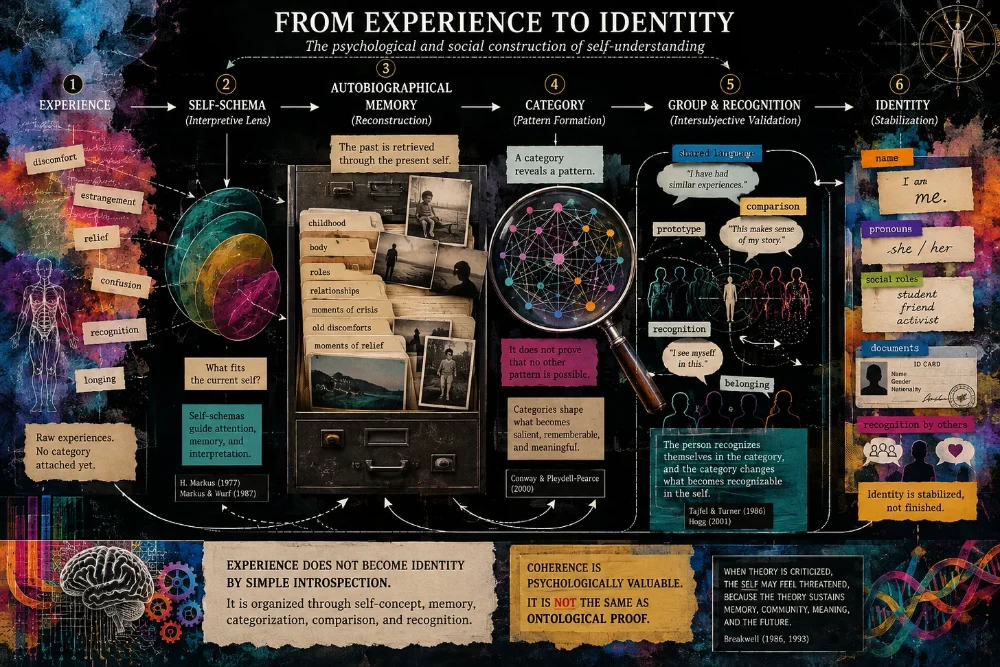
From Experience to Identity
The previous section distinguished the presence of an experience from its causal interpretation and social categorization.
The next question is how these levels become connected. How does a bodily or emotional experience become part of an identity narrative?
Experience does not arrive with a ready-made social classification attached to it.
Discomfort, estrangement, or relief does not in itself tell us which category explains it, which earlier events belong with it, or which group membership follows from it. These meanings emerge through the self-concept, memory, social categorization, and the responses of others.
The Self-Concept Is Not an Internal Inventory
According to Hazel Markus’s classic theory of self-schemas, people develop cognitive generalizations about themselves from past experience, and these schemas then guide how self-relevant information is processed.
A self-schema influences which events are noticed quickly, what is remembered more easily, and which features of experience come to matter for the person’s sense of self.
Markus and Wurf later described the self-concept as a dynamic interpretive structure. It does not simply store information about the person; it actively organizes experience and behavior.
People do not first collect neutral experiences and only later attach the correct label to them. They interpret what happens through an existing sense of who they are.
The same discomfort may look like shyness, role conflict, gender nonconformity, bodily estrangement, or evidence of an identity, depending on the concepts available and the question the person is trying to answer.
Identity emerges as some experiences are brought together and made more significant than others within a larger account of the self…
What Becomes Visible Once It Has a Name
_Encountering a new identity concept can bring previously disconnected experiences into focus: e_arlier discomfort with the body, resistance to certain social roles, unease around forms of address, and relief associated with a new name may begin to look like parts of the same story.
The concept does more than name an unchanged inner reality. It also affects what the person notices and which experiences appear relevant.
A category can make an overlooked pattern visible while also shaping what will count as evidence for it.
This process is not unique to identity. Self-schemas make attention and memory selective more generally. Once a trait or category becomes central to the self-concept, information that fits it is processed more readily and recalled more easily.
A category may therefore identify a real pattern without establishing that it is the only possible interpretation, or that every experience gathered beneath it has the same cause.
The Past Acquires a New Meaning
The formation of identity often reorganizes a person’s life story retrospectively. In Conway and Pleydell-Pearce’s self-memory system, autobiographical memories are not unchanged recordings that are simply retrieved.
They are reconstructions shaped by autobiographical knowledge and by the current goals and self-conception of the working self.
When someone finds a new explanation for themselves, earlier events may acquire a different meaning. A childhood behavior that once appeared merely unusual can later be interpreted as an early sign. An old conflict previously understood as familial, bodily, or social may become one stage in an identity-development narrative.
‘I always knew’ narratives can therefore reflect several psychological processes. They may describe a genuinely persistent and early-recognized experience. They may also involve retrospective coherence, in which the present identity arranges previously ambiguous memories into a continuous story. These possibilities are not mutually exclusive. A durable experience may itself become narratively coherent only later.
The reconstructive character of memory does not automatically make it false. Autobiographical memory ordinarily works in this way.
Present concerns shape the past we search for and the events from which we build an account of who we have become.
Social Categories Also Organize Perception
Self-categorization theory holds that people do not always perceive themselves solely as unique individuals. Under certain conditions, they become salient to themselves as members of a social group.
The category then does more than name a group membership. It reorganizes which similarities and differences appear relevant. People perceive greater commonality with members of their own group and partly interpret themselves in relation to the prototypes associated with that group.
This does not necessarily imply imitation or the disappearance of individual differences… The category instead provides a perspective from which particular traits and experiences become more significant.
A person may recognize themselves in the narratives articulated by a community, while those narratives also shape what they begin to recognize in their own past and present.
A person recognizes themselves in the category, but the category also changes what becomes recognizable in the self.
The process is reciprocal:
- personal experience may motivate movement toward a group,
- while the language and comparative framework offered by the group further organize the interpretation of that experience.
The Psychological Value of Coherence
Identity categories perform an orienting as well as a descriptive function.
They can connect past and present, place an individual in relation to others with similar experiences, and make a future imaginable. A previously diffuse problem may acquire a name, a community, and a direction for action…
Hogg’s uncertainty-identity theory proposes that uncertainty about oneself and one’s social position can increase the appeal of clearly defined groups.
Group prototypes can offer answers to questions such as who one is, how one should understand one’s situation, and what forms of conduct are expected.
The reduction of uncertainty does not show that an identity is false… Nor does it establish that a category serves only to satisfy a psychological need. It does, however, remind us that the psychological usefulness of an explanation and its ontological truth are distinct questions.
An interpretation may organize a life, reduce anxiety, and provide community. These are important consequences. They do not by themselves establish that the interpretation is exhaustive, exclusive, or theoretically correct.
The Social Stabilization of Identity
Identity can become more durable through social recognition. The use of a name, pronoun, or category by others does more than provide confirmation. It incorporates the self-interpretation into ordinary relationships.
The identity appears in forms of address, documents, community roles, and other people’s expectations. In this way, it develops from a personal interpretation into a socially maintained position of the self.
At this point, self-identification is no longer exclusively an internal claim. It also makes demands on the language of others and on institutional practices…
This does not make the demand unjustified, but it explains why the question cannot be settled solely by appealing to the authority of introspection.
Once a self-description modifies shared language and institutional classification, it also becomes an intersubjective and political matter.
When Criticism of the Theory Becomes a Threat to the Self
If an identity category organizes memory, reduces uncertainty, provides community, structures the future, and secures social recognition, criticism of that category may no longer be experienced as criticism of a single abstract proposition.
It may threaten the stability of an entire system of self-interpretation.
Breakwell’s identity process theory draws attention to the processes through which identity maintains continuity, distinctiveness, self-esteem, and self-efficacy.
When these principles are threatened, people may adopt various coping strategies in an effort to restore equilibrium.
This helps explain why theoretical scrutiny of a category can be experienced as personal rejection.
If the theory also sustains the coherence of a life story and the legitimacy of group membership, questioning it may reach far beyond a conceptual dispute. The experience of threat, however, does not determine the truth value of the objection. It explains the intensity of the response, but it cannot replace examination of the argument.
Once an identity category organizes memory, community, moral status, and expectations for the future, criticism of the category may be experienced as criticism of the self. That experience is psychologically intelligible. It does not establish that the criticism is conceptually mistaken.
Identity does not therefore emerge directly from experience. Between the two lie cognitive schemas, reconstructed memories, social comparisons, collective narratives, and practices of recognition.
These processes do not merely distort an underlying inner reality. They make it possible for a person to construct an intelligible account of themselves in the first place.
The next question is therefore no longer whether self-interpretation is mediated. It is whether any form of self-understanding could exist without historically inherited concepts and prior interpretive frameworks. This is where Gadamer becomes necessary.

Gadamer and the Conditions of Self-Understanding
Gadamer’s philosophical hermeneutics places the psychological findings on mediated self-interpretation within a broader framework.
We do not encounter ourselves or the world as minds without prior assumptions. We inherit language, categories, and interpretive traditions that already guide attention before a question is examined consciously.
For this reason, Gadamer does not use prejudice only to mean irrational bias.
The term also refers to prior judgments and expectations without which something could not become intelligible at all. Such assumptions do not merely distort understanding. They also make it possible.
Applied to identity, this means that a person does not first encounter a fully pre-conceptual inner reality and only later select the appropriate name for it.
Even the recognition of an experience as bodily estrangement, role conflict, dysphoria, or an experience of identity depends on historically available concepts.
This does not imply that every interpretation is equally valid. For Gadamer, prior assumptions remain open to revision.
Understanding becomes productive when the interpreter’s horizon encounters something that resists it and forces earlier concepts to change.
The ‘fusion of horizons’ is therefore not a matter of simply adopting another person’s point of view. It describes the emergence of a new interpretive situation in which both the object of understanding and the interpreter’s original concepts may be altered.
The important distinction, then, is not between mediated and unmediated self-interpretation. All self-understanding is mediated.
The distinction is between open and closed interpretive systems.
- In an open interpretation, a concept helps make an experience intelligible, but the experience can also modify the concept.
- A closed system, by contrast, can convert every possible case into confirmation.
A matching experience supports the framework… a conflicting one is explained as repression, social pressure, or another expression of the same underlying phenomenon.
The framework can account for everything because nothing is allowed to limit it.
The social origin of an identity concept therefore does not, by itself, invalidate it. Nor does the coherence it provides automatically establish its truth.
The more relevant questions are whether the concept distinguishes among different experiences, recognizes the limits of its application, and permits new evidence to revise it.
Gadamer thus helps avoid the false choice between identity as a purely inner truth and identity as nothing more than an external construction.
Mediation does not make self-interpretation false. It makes it untenable to treat self-interpretation as a certainty independent of conceptual and historical conditions.
This leads to the next question. If all self-understanding is historically and linguistically mediated, how does the narrative become so powerful that a person’s true identity was always already present in complete form and merely waiting to be recognized?

When Contradiction Becomes Inclusion
The detour through introspection, memory, self-categorization, and hermeneutics brings us back to Inzlicht’s original problem in a more precise form.
I_nquiry never begins without prior concepts. Even deciding what counts as data, which experiences belong together, and which differences matter already requires theoretical assumptions._
The key issue lies beyond the debate over induction and deduction. Concepts inevitably frame what we notice, while experience retains the power to revise them. The system breaks down when this dialogue stops… when theory continues to impose structure on experience, but experience loses all ability to talk back.
In Inzlicht’s case, moral conviction influenced which findings appeared credible, which required further analysis, and which conclusions became difficult to accept in advance.
The method could change while the normative direction remained fixed.
A similar structure can appear in theories of identity.
The same politically recognized identity claim may be justified through theories that are difficult to reconcile with one another.
- One common account of binary transgender identity holds that a person possesses a deep, enduring, and authentic gender identity. This identity is not chosen but discovered. The body and the category assigned at birth may be mistaken about who the person really is.
- Queer and some nonbinary approaches, by contrast, question the idea of a stable gender essence. They treat gender categories as historically produced, socially maintained, and open to transformation. A person may not be discovering a hidden and unchanging identity, but reinterpreting, crossing, or refusing the categories available to them.
The two models offer different answers to what makes an identity claim true.
One appeals to an already existing inner reality. The other questions the priority of stable essences and fixed categories.
Politically, they may nevertheless belong to the same coalition.
What unites them is probably not a shared ontology of gender, but the normative principle that a person’s self-definition possesses primary moral authority. The theoretical explanations may differ as long as they support the same conclusion: the identity named by the person ought to be recognized by others.
The figure of the queer transgender Muslim makes this structure especially visible.

A person may sincerely experience all three affiliations and refuse to let any single community define them completely.
That lived coexistence may be real. It does not demonstrate that the theoretical and normative systems underlying those identities are compatible.
The three frameworks may locate the final authority of self-interpretation in different places.
- An essentialist transgender model appeals to a deep inner identity.
- Queer anti-essentialism emphasizes the critique and reconstruction of categories.
- A religious tradition may locate authority in revelation, a created order, or an inherited interpretive community that individual self-definition cannot override without limit.
These frameworks may make competing claims about the meaning of the body, the source of moral obligation, and who has the authority to determine a person’s social position.
Personal self-description may still present them as a harmonious whole. This does not necessarily involve deception… people can live with partly unresolved commitments.
Lived coherence, however, is not the same as theoretical consistency.
The existence of a queer transgender Muslim shows that a person can claim all three affiliations. It does not show that the communities, doctrines, and institutions associated with them recognize one another.
Consensual same-sex relations remain criminalized in a number of Muslim-majority states, while some legal systems also restrict gender expression or the public lives of transgender people.
Legal and social conditions vary widely across Muslim-majority countries, and Muslim communities are internally diverse…
That diversity should not, however, be used to redescribe criminalization, exclusion, or institutional repression as merely another form of cultural difference.
A harmonious representation can turn a real relation of power into aesthetic pluralism.
Queer, transgender, and Muslim identities appear beside one another as equally vulnerable affiliations, even where institutions connected to one of them legally, morally, or physically restrict the lives represented by the others.
A person may reinterpret their faith, draw on minority theological traditions, or separate belief from institutional religious authority. That may involve serious personal and theological work. It does not follow that the wider social conflict has disappeared.
Personal reconciliation and institutional acceptance are different claims.
Inclusive representations of multiple identities can therefore be both emancipatory and misleading…
They can make visible people whom several communities attempt to place outside their boundaries. At the same time, such representations can suggest that contradiction has already been resolved through the act of self-definition alone.
This reflects a broader neoliberal tendency to relocate structural conflict within the individual. The person is expected to reconcile incompatible normative systems, reinterpret exclusion as a problem of personal coherence, and develop the resilience required to live within institutions that remain unchanged. Recognition becomes symbolic and psychological, while the legal, theological, and political structures producing the conflict escape comparable scrutiny.
The individual is expected to perform internally the reconciliation that society has refused to undertake institutionally.
It is precisely this constraint that gives self-definition moral priority… because the person must create the conditions under which these commitments can coexist, criticism of the identity unity they construct can easily appear as yet another external imposition.
When a person applies all three identities to themselves, contemporary norms of inclusion often treat this self-description as though it had already settled the conflicts among them…
Examination of the ontological, theological, and political tensions can then appear to challenge the person’s authenticity or self-knowledge.
Yet these two questions can be separated… A person’s self-description may be sincere, meaningful, and deserving of dignity even when the theories brought together within it genuinely contradict one another.
Accepting the person does not require treating every theoretical claim associated with their identities as mutually consistent or socially harmless.
The same applies to the limits of recognition…
A person may reasonably expect to be treated with dignity and fairness. Self-definition alone, however, cannot require others to accept the entire ontology attached to that self-understanding as true, or to adjust their own philosophical, religious, or scientific convictions accordingly.
Recognition of the person is not the same as acceptance of the theory.
When someone defines themselves as a queer transgender Muslim, this shows that they can hold these affiliations together within their own life…
It does not follow that they can prescribe the same unity intersubjectively for others.
This is especially true of those who live within the actual conflict among the normative systems involved… people whose sexuality, gender expression, or social presence is restricted by religious, legal, or communal institutions. For them, the contradiction is not an abstract theoretical difficulty that an inclusive self-description can resolve. It forms part of the material and political conditions of their lives.
Self-definition may express a person’s refusal to surrender any of these affiliations. It cannot oblige others to regard the conflict among them as resolved, or to subordinate their own experiences to another person’s internal coherence. Recognizing the person does not require denying a real contradiction.
Self-definition can therefore express a social and interpersonal claim, but it does not by itself establish the truth of the theories associated with an identity, reconcile opposing normative systems, or substitute for institutional change. A demand for respect cannot automatically become a demand for epistemic or moral agreement.
Indeed, suppressing these contradictions may depoliticize the position of the person concerned.
When the conflict is presented solely as a matter of individual identity work, it becomes less visible that certain communities and institutions actively restrict the forms of life the person is attempting to reconcile within themselves. A harmonious self-description can therefore conceal the asymmetry that not all identities possess equal institutional power, and not all bear equal risks in their coexistence.
When symbolic inclusion takes the place of structural change, the contradiction is not resolved but privatized. Moreover, it becomes more than the internal burden of the individual attempting to hold several identities together.
It may also demand silence from those who continue to bear the institutional consequences of the contradiction…
This returns us to Inzlicht’s problem. When opposing theories are accepted because they support the same desirable normative conclusion, while analogies or counterexamples that threaten it are treated as morally suspect, the conclusion once again precedes the inquiry.
Complex human experience can be interpreted at several levels. The difficulty begins when contradictions among those interpretations cease to matter as long as each performs the same legitimating function.
Theories are then judged less by how accurately they describe reality than by whether they protect the desired moral outcome.
A humane conclusion does not exempt the framework supporting it from scrutiny. Once the outcome is fixed, incompatible theories can be retained, counterexamples moralized away, and institutional conflict redescribed as personal complexity. The framework ceases to be answerable to reality. It reorganizes reality so that correction never becomes necessary.
Resources
Bettcher, T. M. (2009). Trans identities and first-person authority. In L. Shrage (Ed.), You’ve Changed: Sex Reassignment and Personal Identity (pp. 98–120). Oxford University Press. PhilPapers
Breakwell, G. M. (1986). Coping with Threatened Identities. Methuen.
Bryant, J., et al. (2025). The problem with resilience: Individualisation, reductionism, and the limits of resilience discourse. International Journal of Environmental Research and Public Health. Full text
Butler, J. (1990). Gender Trouble: Feminism and the Subversion of Identity. Routledge.
Conway, M. A., & Pleydell-Pearce, C. W. (2000). The construction of autobiographical memories in the self-memory system. Psychological Review, 107(2), 261–288. https://doi.org/10.1037/0033-295X.107.2.261
Danziger, K. (1980). The history of introspection reconsidered. Journal of the History of the Behavioral Sciences, 16(3), 241–262. https://doi.org/10.1002/1520-6696(198007)16:3%3C241::AID-JHBS2300160306%3E3.0.CO;2-O
Dembroff, R. (2020). Beyond binary: Genderqueer as critical gender kind. Philosophers’ Imprint, 20(9), 1–23. Full text
Gadamer, H.-G. (2004). Truth and Method (J. Weinsheimer & D. G. Marshall, Trans.; 2nd rev. ed.). Continuum.
Hogg, M. A. (2007). Uncertainty–identity theory. Advances in Experimental Social Psychology, 39, 69–126. https://doi.org/10.1016/S0065-2601(06)39002-8
ILGA World. (2024). Laws on Us: A Global Overview of Legal Progress and Regression on Sexual Orientation, Gender Identity, Gender Expression, and Sex Characteristics. Report overview
ILGA World. (n.d.). Criminalisation of Consensual Same-Sex Sexual Acts. ILGA World Database. Database
Inzlicht, M. (2026, July 22). My p-hacking felt like truth. Speak Now Regret Later. Essay
Jenkins, K. (2016). Amelioration and inclusion: Gender identity and the concept of woman. Ethics, 126(2), 394–421. https://doi.org/10.1086/683535
Kunda, Z. (1990). The case for motivated reasoning. Psychological Bulletin, 108(3), 480–498. https://doi.org/10.1037/0033-2909.108.3.480
Malpas, J. (2022). Hans-Georg Gadamer. In E. N. Zalta & U. Nodelman (Eds.), The Stanford Encyclopedia of Philosophy. Entry
Markus, H. (1977). Self-schemata and processing information about the self. Journal of Personality and Social Psychology, 35(2), 63–78. https://doi.org/10.1037/0022-3514.35.2.63
Markus, H., & Wurf, E. (1987). The dynamic self-concept: A social psychological perspective. Annual Review of Psychology, 38, 299–337. https://doi.org/10.1146/annurev.ps.38.020187.001503
Nisbett, R. E., & Wilson, T. D. (1977). Telling more than we can know: Verbal reports on mental processes. Psychological Review, 84(3), 231–259. https://doi.org/10.1037/0033-295X.84.3.231
Schwitzgebel, E. (2008). The unreliability of naïve introspection. The Philosophical Review, 117(2), 245–273. https://doi.org/10.1215/00318108-2007-037
Simmons, J. P., Nelson, L. D., & Simonsohn, U. (2011). False-positive psychology: Undisclosed flexibility in data collection and analysis allows presenting anything as significant. Psychological Science, 22(11), 1359–1366. https://doi.org/10.1177/0956797611417632
Turner, J. C., Hogg, M. A., Oakes, P. J., Reicher, S. D., & Wetherell, M. S. (1987). Rediscovering the Social Group: A Self-Categorization Theory. Basil Blackwell.
Tuvel, R. (2017). In defense of transracialism. Hypatia, 32(2), 263–278. https://doi.org/10.1111/hypa.12327
Watson, J. B. (1913). Psychology as the behaviorist views it. Psychological Review, 20(2), 158–177. https://doi.org/10.1037/h0074428
Wilson, T. D., & Dunn, E. W. (2004). Self-knowledge: Its limits, value, and potential for improvement. Annual Review of Psychology, 55, 493–518. https://doi.org/10.1146/annurev.psych.55.090902.141954